by Cosima Malandrino | Jun 8, 2018
Source: Ecomuseo Casilino http://www.ecomuseocasilino.it/
| Location |
Rome |
| Name |
Eco Museo Casilino |
| Community |
Level |
Street / Neighborhood |
| Sector |
Regenaration and valorisation of urban heritage |
| Year of beginning |
2009 (the idea) – 2011 (City Council Deliberation) |
| People involved |
Citizens, schools, association, parishes, firms. |
| Who started the initiative (NGO, public administration, association) |
Association Ecomuseo Casilino Duos |
| Type of commons |
Archeological, |
| Object |
The Eco Museo Casilino project wants to restore the agricultural, natural and archaeological areas against progressive increase in construction. The aim is to recover the relationship people have with the ground. The museum delivers many services, as green transports, rentals,tourist information service, sports service, restaurants, cycle path.
This project is the result of a work expressed by a civic network in the V City Hall (ex VI). The genesis of the Ecomuseum is so typical of the “pact with which a community decides to take care of its territory” based on the principle of subsidiarity (art. 118 Cost.). It is a participatory design process open to contributions and instances of citizens, Schools, associations, businesses, parishes. |
| Field |
Urban |
| Source |
Website |
| Website |
http://www.ecomuseocasilino.it/ |
Rome
by Cosima Malandrino | Jun 8, 2018
Source: Vogue Italia http://www.vogue.it/people-are-talking-about/vogue-arts/2014/03/il-premio-ecf-al-teatro-valle
| Country |
Italy |
| City |
Rome |
| Name |
Teatro Valle Foundation |
| Year of beginning |
2013 |
| Description |
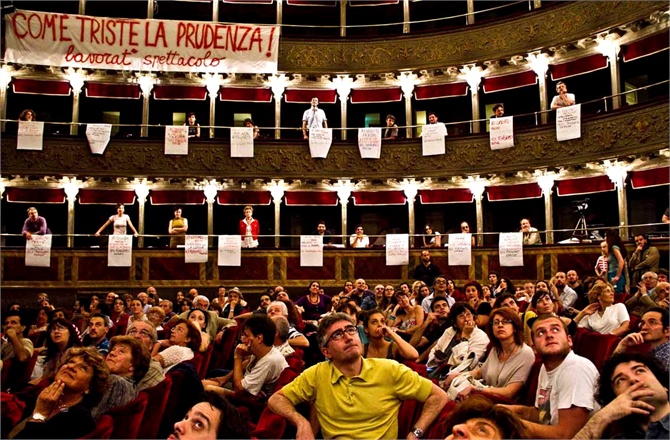
The Teatro Valle Foundation was created in 2013 after two years of occupation of the Teatro Valle in Rome, Italy.
With the aim of taking over the abandoned theatre in the center of Rome, and tackling the inertia of public institutions regarding the care and investment in the artistic and cultural sector, this citizens initiative has initiated an innovative process to rethink the way cultural institutions are managed in the city.
Thanks to the contributions of two legal experts, Ugo Mattei and Stefano Rodotà, the Teatro Valle Foundation embodies an alternative legal framework in order to take care of the urban commons outside of the dichotomous private – public management solution.
This solution envisages a participative, horizontal, and cooperative management of urban public goods in order to provide a framework for self-government in partnership and with the support of public and private actors and promote a new idea of citizenship. |
| Urban Co-Governance |
Moderate |
| Enabling State |
Moderate |
| Pooling |
Moderate |
| Experimentalism |
Strong |
| Tech Justice |
Weak |
| Website |
http://www.teatrovalleoccupato.it/chi-siamo |
| References, sources, contact person(s) |
Website, Teatro Valle Foundation; Labsus, http://www.labsus.org/2013/09/fiocco-rosa-nasce-la-fondazione-teatro-valle-bene-comune/
Contact : teatrovalleoccupato@gmail.com |
Rome

by Cosima Malandrino | Jun 8, 2018
 Source: Cronache di Ordinario Razzismo http://www.cronachediordinariorazzismo.org/fuori-campo-medici-senza-frontiere-metropoliz/
| Country |
Italy |
| City |
Rome |
| Name |
MAAM Rome Metropolitan museum in Prenestino (also Museo dell’Altro e dell’Altrove)
|
| Date |
2012 |
| Description |
Continuing the work of the Space Metropoliz artistic, cinema, and ethnographic project, MAAM arises in an occupied old factory as an open public space that welcomes new forms of artistic experimentation and social cooperation.
Art becomes a collective endeavour in this space, as artists are invited to contribute for free, interacting with the factory and the inhabitants of the neighborhood.
The Project puts forward a new model for artistic institutions, and contributed to create a new relationship linking artistic expression, politics and the city. Starting from its name, the “Museum of the Other and the Elsewhere” is indeed symbolically opposing the idea of art that shows through the work and the esthetic of the MAXXI and MACRO museums, using its peripheral position, its complete absence of funds and its proximity to the community as its strength. |
| Urban Co-Governance |
Moderate |
| Enabling State |
Weak |
| Pooling |
Moderate |
| Experimentalism |
Strong |
| Tech Justice |
Moderate |
| Website |
http://www.museomaam.it/ |
| References, sources, contact person(s) |
City of Rome Official Tourist Site http://www.turismoroma.it/cosa-fare/maam-museo-dellaltro-e-dellaltrove
Facebook Page : https://www.facebook.com/museoMAAM/
Contact : giorgiodefinis@gmail.com |
Rome

by Cosima Malandrino | Jun 8, 2018

Source: Screenshot 2022-05-06 https://www.southbronxunite.org/community-land-trust
| Country |
United States |
| City |
New York City |
| Name |
Mott Haven and Port Morris CLT |
| Date |
2016 |
| Description |
The community land trust (CLT) seeks to put into practice what South Bronx Unite has been pushing the state and city to do since 2012: involve the community in the development of public spaces and let Bronx residents have a say in what happens to their neighborhood.The CLT is indeed a tool to strike back against decades of environmental abuse in the area that’s been brought on by power plants, waste transfer stations, and companies like FreshDirect whose new distribution plant, Dissent Magazine notes, will add 1,000 truck trips per day to an area already choked with air pollution.
The Community Land Trust, a nonprofit where a group of people own and manage land, will help to empower residents of Mott Haven and Port Morris to have a say in the use of the neighborhoods’ underutilized space.
If the organization has already formed the Community Land Trust, it has yet to acquire any properties—however, it has its eyes on two city-owned vacant sites. Under the CLT, development on sites it owns would have to be led or approved by members of the trust.
Finally, the Mott Haven-Port Morris Community Land Trust has sought to put pressure on real-estate interests entering the neighborhood (including Somerset Partners, Carnegie Management, and Savanna) with their Statement of Principles for Private Development. The statement addresses eight points: jobs, housing, environmental justice, community art, community cohesiveness, local economic development, health equity, and public-private projects. It notably calls on private developers to support the Waterfront Plan, a community-designed plan to provide public green space and waterfront access to Bronx residents. |
| Urban Co-Governance |
Weak |
| Enabling State |
Moderate |
| Pooling |
Weak |
| Experimentalism |
Weak |
| Tech Justice |
Weak |
| Project Website |
https://www.southbronxunite.org/community-land-trust |
| References, sources, contact person(s) |
Zoe Rosenberg,”These award-winning proposals will tackle the city’s public space inequity”, Curbed New York, 2017
Raven Rakia, “Who Benefits from Public Land in the Bronx?” Dissent Magazine, 2016
Contact : info@southbronxunite.org |
New York City

by Cosima Malandrino | Jun 8, 2018
 Source: Accorderies, http://jesoutiens.accorderie.fr/rejoignez-la-communaute/projects/205
| Country |
France |
| City |
Montpellier |
| Name |
Accorderie |
| Date |
2013 |
| Description of the project |
Inspired by the Accorderie Network that was born in Québec in 2002, the Accorderie of Montpellier was established in 2013 by active citizens reunited in an association called “ Collectif Montpelliérain Pour Une Accorderie Et D’autres Solidarités Réciproques (COMASOR)”. As part of a wider program to transfer the accorderie model in France, the Montpellier accorderie was supported by the Foundation Macif and officially entered the French Accorderie Network in 2014.
The Accorderie model is established on the principle of mutual cooperation and service exchange within neighborhood communities without using financial means. Concretely, this means that a member can dedicate an hour to the accorderie by completing a service (ie. english lessons, fixing computers, gardening), getting as a consequence an hour of credit that he can use by benefiting from a service done by another member. |
| Urban Co-Governance |
Moderate |
| Enabling State |
Moderate |
| Pooling |
Moderate |
| Experimentalism |
Moderate |
| Tech Justice |
N/A |
| Project Website |
http://www.accorderie.fr/montpellier/page-d-exemple/ |
| References, sources, contact person(s) |
Accorderies Montpellier. Source: Website http://www.accorderie.fr/montpellier/page-d-exemple/
Contact : montpellier@accorderie.fr |
14 rue Durand 34000, Montpellier
