
by Staff | Aug 14, 2019

Image source: https://landemtl.com/portfolio/larpent-vert-demarche-citoyenne/
| Country |
Canada |
| City |
Montreal |
| Name |
Lande |
| Date |
2015 |
|
Description of the project
|
Lande collaborates with community organizations and individual entrepreneurs based on the shared responsibility principle. Lande members work along with multiple non-profit organization for the greening (Sentier urbain), but also also with Solon Collectif, La Pépinière, or the Centre d’économie urbaine. Local organisation “eco quartiers” provide for compost bins. The public sector is represented by the arrondissement and the city of Montreal.
The initiative developed into a business with people From its first year of existence in 2015, the purpose of Lande is to support citizens in the appropriation of vacant land in a three steps process “mapping, supporting, transforming”. The first tool provided is indeed a map online on which they can localize the land. When Lande sees a growing interest for one specific land, a billboard is installed on the vacant land to affirm the intention of appripriation. They put in relation designer and gardeners and others local structures/organisations with people to help them in accomplishing their idea and wishes. The role of Lande members, mainly volunteers, is to facilitate the process, delegating the tasks, providing tools, advising on the negociation process and adapting their support to each citizen/community/organisation specific request. Empowering is Lande’s key mission. Among the main roadblock faced are: the contact with private owners when the land is private is usually difficult as it appears necessary to gain his/her confidence (hence the preference for public land). They use many entry points to mobilise people, community gardens, community spaces more generally. |
| Urban Co-Governance |
Strong |
| Enabling State |
Strong |
| Pooling |
Strong |
| Experimentalism |
Moderate |
| Tech Justice |
Moderate |
| Website |
https://landemtl.com/ |
| References, sources, contact person(s) |
Questionnaire,
Site https://landemtl.com/portfolio/larpent-vert-demarche-citoyenne/
Contact : info@landemtl.com |
Montréal

by Chiara De Angelis | Jun 8, 2018
| Country |
South Africa |
| City |
Bergrivier |
| Name |
Flow |
| Date |
2012 |
| Description of the project |
The FLOW Project is currently going through a transition process from research project (it was born as a two-years project at Cape Town University) to independent entity, having as a main aim the facilitation of the “commons transition”. The project is active in three areas of SouthAfrica: the local Municipality of Bergrivier, the city of Kokstad and the suburb of Bo-Kaap. In Bergrivier, FLOW has developed the Climate Change Adaption Plan. The project involves the local unoccipied youth – the FLOW Ambassadors – to build individual and community capabilities in order to stimulate growth and to produce innovation in the fields of climate change, exploitation of resources and inequality |
| Urban Co-Governance |
Strong |
| Enabling State |
Strong |
| Pooling |
Moderate |
| Experimentalism |
Moderate |
| Tech Justice |
Moderate |
| Project Website |
http://www.flowafrica.org |
| References, sources, contact person(s) |
Interview to Anna Cowen and John Ziniades (co-founders of the FLOW project); website
info@flowafrica.org |

by Chiara De Angelis | Jun 8, 2018

Image source : http://hacklabcbba.org/
Cochabamba
by Chiara De Angelis | Jun 8, 2018
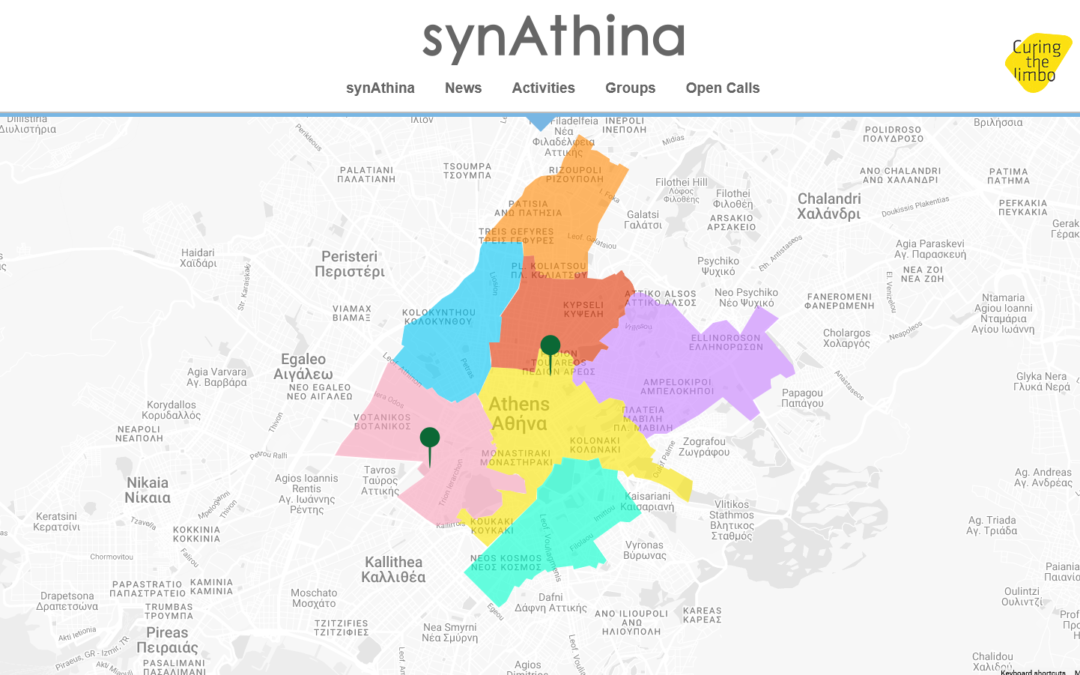
 Image credit : Logo and Screenshot(21/04/2022)from http://www.synathina.gr/en/
| Country |
Greece |
| City |
Athens |
| Name |
SynAthina |
| Date |
2013 |
| Description |
SynAthina is a community platform based in the city of Athens, created for impuls of Athens Municipality, that connects, facilitates and supports citizens groups involved in the amelioration of the quality of life in Athens. Several tools are made available for citizens: the web platform, the SynAthina kiosk (meeting point) and thematic meeting. From its launch in 2013, SynAthina has hosted 2227 activities realized by 259 groups of citizens and institutions |
| Urban Co-Governance |
Weak |
| Enabling State |
Strong |
| Pooling |
Moderate |
| Experimentalism |
Strong |
| Tech Justice |
Strong |
| Website |
http://www.synathina.gr/el/ |
| References, sources, contact person(s) |
Interview to Amalia Zepou (Athens deputy mayor, foundator of SynAthina); website
Facebook page : https://www.facebook.com/SunAthina/
Contact : info@synathina.gr |
Athens

by Chiara De Angelis | Jun 8, 2018
Source: Website http://mazinst.org/
| Country |
Kenya |
| City |
Nairobi |
| Name |
Mazingira Institute |
| Date |
1978 |
| Description of the project |
Mazingira Institute works on interdisciplinary research and action in order to create knowledge and social change, and acts as a facilitator for the urban farmers’ organizations. The Institute covers several disciplines such as policy analysis, advocacy, political action and activism. As a part of civil society in Kenya, it gave its contribution to many legal, political and constitutional reforms. |
| Urban Co-Governance |
Moderate |
| Enabling State |
Moderate |
| Pooling |
Moderate |
| Experimentalism |
Moderate |
| Tech Justice |
Weak |
| Project Website |
http://www.mazinst.org/ |
| References, sources, contact person(s) |
Mazingira Institute, Nairobi. Sources: Interview to Diana Lee-Smith and Davinder Lamba (co-founders of the Mazingira Institute); Website: http://www.mazinst.org/
Contact : info@mazinst.org |
nairobi
